
GHG accounting, Decarbonisation & Impact on ESG ratings
Enhance your ESG score and stand out globally. Discover how EcoVadis certification and sustainability strategies drive business growth.
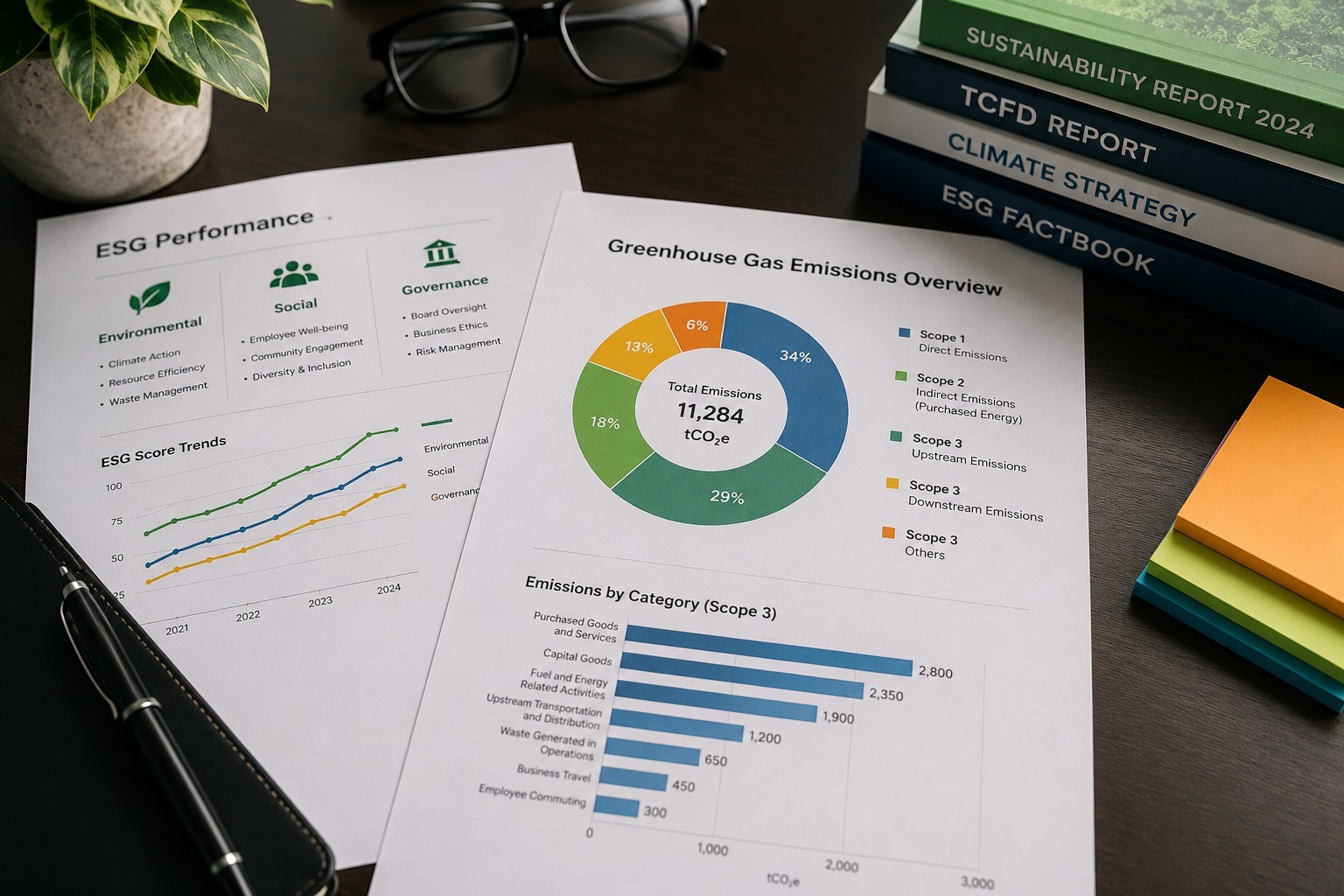
GHG accounting, Decarbonisation & Impact on ESG ratings
The increasing need of regulatory compliance for Green House Gas (GHG) accounting and it being an important metric of Sustainability reporting, GHG accounting holds one important position that can manoeuvre the sustainability impact in positive or negative way. Let’s explore how GHG accounting evolved, its impact on ESG ratings and how it frames decarbonisation roadmaps for a reporting organisation.
Evolution of Carbon Foot printing
Carbon foot printing has progressed from scientific research to a strategic business capability. The Intergovernmental Panel on Climate Change (IPCC), United Nations Framework Convention on Climate Change (UNFCCC), Kyoto Protocol, and Paris Agreement all helped to shape today’s carbon accounting ecosystem. Businesses are now measuring emissions across operations, products, and value chains using globally recognized standards and digital technologies.
Meanwhile, regulatory and voluntary frameworks accelerated evolution. Examples include science-based objectives, which typically necessitate Scope 1-3 accounting. In short, the fundamentals of carbon foot printing solidified during the 2000s, laying the groundwork for today’s advanced practices.
As India accelerates its transition to a low-carbon economy, businesses are expected to measure and manage emissions throughout the entire value chain. For many organizations, Scope 3 emissions make up the majority of their carbon footprint, making them critical to achieving net-zero goals, meeting ESG reporting requirements, and strengthening supply chain resilience. Understanding and addressing Scope 3 emissions allows businesses to identify reduction opportunities, boost stakeholder confidence, and maintain competitiveness in a rapidly changing global market.
GHG Accounting: The Essentials for a Successful Decarbonization Journey
GHG accounting is the foundation of a successful climate strategy. Measuring and assessing emissions across Scope 1, Scope 2, and Scope 3 gives businesses the ability to make data-driven decisions, identify carbon hotspots, prioritize reduction opportunities, and assess long-term financial benefits from carbon accounting.
Previously driven primarily by regulatory compliance, this is now evolving into a business strategy. Businesses now understanding the grit of carbon accounting and reduction have begun investing in carbon foot printing and decarbonization plans to reduce costs, improve supply chain resilience, address climate risks, attract investors, and create new market opportunities.
Decarbonisation Roadmap
“Decarbonization is the reduction and removal of carbon dioxide and other greenhouse gases from the atmosphere.”
While the term “decarbonisation” refers to the ‘removal of’ carbon emissions from the atmosphere, planning, implementing, managing, and carving out a decarbonisation plan presents a significant challenge to existing industries. While regulations and climate compliance necessitate decarbonization, the research begins by examining the challenges at each stage of the supply chain and operations. The first step in breaking the ice is always to collect and map the Scope 1, 2, and 3 emissions.
The Decarbonisation Roadmap – The saga of going green!
For any legal entity, well-organized and reported data and metrics are often linked to effective decision making and the ability to develop a strong strategy. A solid decarbonization plan that aids an organization in eliminating its greenhouse gas emissions while upholding its business metrics is built on well-organized and documented data about its carbon emissions. A successful decarbonization strategy will include the following steps.
- Emissions mapping – Scope 1,2 and 3
- Baseline setting and Emission reporting Gap Analysis
- Decarbonisation targets – Long, medium and short-term reduction goals
- Identifying high emission operational areas and risk identification
- Identifying emission reduction opportunities and feasibilities
- Stakeholder engagement and on boarding
- Evaluating available solutions and technologies for carbon removal
- Accountability, monitoring, reporting and disclosure of the solution implementation
- Continuous improvement
In addition to maintaining business performance and generating long-term business value, a robust RACI with sufficient, effective measuring and reporting will result in excellent attainment of objectives.
ESG Ratings, GHG Accounting & ESG Rating Agencies
Accurate GHG accounting is an important aspect of ESG performance. Organizations can demonstrate transparency, monitor climate-related risks, and support credible sustainability disclosures by measuring and reporting emissions at all three levels. Reliable carbon data serves as the foundation for many ESG assessments and decarbonization initiatives.
Leading ESG rating agencies assess companies based on publicly available information, sustainability reports, climate disclosures, governance practices, and industry-specific performance metrics. Their assessments assist investors and stakeholders in comparing organizations’ ESG performance and identifying long-term sustainability risks and opportunities.
Accurate GHG accounting also facilitates compliance with global reporting frameworks such as the GHG Protocol, CDP, IFRS S2, CSRD, and BRSR, thereby increasing the credibility of ESG disclosures and lowering the risk of greenwashing. GHG accounting has a direct impact on ESG ratings because climate performance is a key component of the Environmental pillar of ESG. Only calculating emissions does not improve ESG rating, but accurate, transparent, and consistent GHG accounting provides evidence for ESG rating agencies to assess climate performance and validate a its climate commitments based on disclosed metrics and reduction in emission numbers.
Digital Spine – Tools for Measuring, recording and Reporting
Accurate GHG accounting depends on trusted data and digital technologies that make the reporting process faster, more transparent and increasingly automated. Leading digital solutions include SAP Sustainability Control Tower, SAP Sustainability Footprint Management, Microsoft Sustainability Manager, Oracle EPM ESG, IBM Envizi, Persefoni, Sweep, Watershed, and Sphera Cloud. These platforms assist organisations in automating emissions calculations, monitoring ESG performance, identifying carbon hotspots, evaluating reduction scenarios, and creating disclosures that are compliant with frameworks such as the GHG Protocol, IFRS S2, CSRD, and BRSR.
How P Cube Can Help with GHG Accounting and Decarbonization Roadmap?
P Cube supports organizations throughout their climate journey by combining sustainability consulting with digital transformation capabilities.
Our expertise includes:
- GHG Accounting aligned with the GHG Protocol and international reporting frameworks.
- Scope 1, Scope 2, and Scope 3 emissions assessments.
- Carbon footprint and emissions hotspot analysis.
- Scope 3 data collection and supplier engagement strategies.
- Decarbonization roadmap development.
- ESG and sustainability reporting support.
- Carbon accounting process design and governance.
- Sustainability data management and reporting automation.
- Digital ESG solutions and KPI dashboards for continuous monitoring.
Whether you are taking the first step in measuring your carbon footprint or advancing toward net-zero commitments, P Cube provides the expertise and digital capabilities to transform emissions data into measurable climate action.